

If you live in Jupiter, Palm Beach Gardens, or anywhere along the Treasure Coast, you already know that long, active days in the Florida sun can take a toll on your legs. What many patients don’t realize is that aching legs, swelling ankles, and visible veins aren’t just “part of getting older” — they’re often early signs of venous disease, a progressive medical condition that responds remarkably well to modern, in-office treatment.
At Abacoa Podiatry & Leg Vein Center in Jupiter, we evaluate patients every week who waited years before seeking help. Most are surprised to learn how quickly their symptoms improve — and how straightforward today’s vein procedures have become.
This guide breaks down the signs that your veins need attention, the difference between cosmetic and medical vein problems, and the minimally invasive treatments available right here in northern Palm Beach County.
Why Leg Vein Problems Are So Common in South Florida
Vein disease affects an estimated 1 in 3 adults in the United States, and South Florida
sees higher-than-average rates for a few specific reasons:
- Heat and humidity cause veins to dilate, which worsens pooling and symptoms
- Outdoor lifestyles (golf, boating, tennis, standing professions) place prolonged strain on leg veins
- An older population — venous insufficiency becomes more common after age 50
- Sun exposure makes spider veins more noticeable cosmetically
If your legs feel heavier after a round at Loxahatchee Club, a day on the boat in the Jupiter Inlet, or a long shift on your feet, your veins may be telling you something.
Are My Vein Problems Medical or Just Cosmetic?
This is the single most common question we hear from new patients — and the answer matters, because medical vein disease is almost always covered by insurance, while purely cosmetic treatment is not
Here’s the simple framework we use:
Likely medical (covered):
- Symptoms like heaviness, aching, cramping, swelling, or restless legs
- Skin changes, discoloration, or ulcers near the ankles
- Bulging varicose veins
- Bulging varicose veins
Likely cosmetic (not covered):
- Small spider veins on the thighs or calves with no symptoms
- No underlying venous reflux on imaging
A proper evaluation with duplex ultrasound is the only way to know for sure. The visible veins on the surface are often just the tip of the iceberg — what’s happening beneath the skin drives the symptoms and dictates the correct treatment.
9 Signs You Should See a Vein Specialist in Jupiter
Many patients wait too long because they assume symptoms are normal. They aren’t — and they almost always get worse without treatment. Schedule an evaluation if you experience any of the following:
- Aching, throbbing, or heaviness in your legs, especially by the end of the day
- Swelling in the ankles or calves that’s worse after standing or flying
- Burning, itching, or a “tired leg” sensation
- Visible spider veins or bulging varicose veins
- Leg cramps at night or restless legs that disrupt sleep
- Skin discoloration — brownish, reddish, or leathery patches near the ankles
- Dry, itchy skin on the lower legs (venous eczema)
- A wound or sore that won’t heal above the ankle
- A family history of varicose veins, blood clots, or DVT
Even one of these symptoms warrants a conversation with a leg vein specialist. Treating vein disease early is easier, more comfortable, and often prevents the more serious complications — including skin ulcers and blood clots — that bring patients in years later.
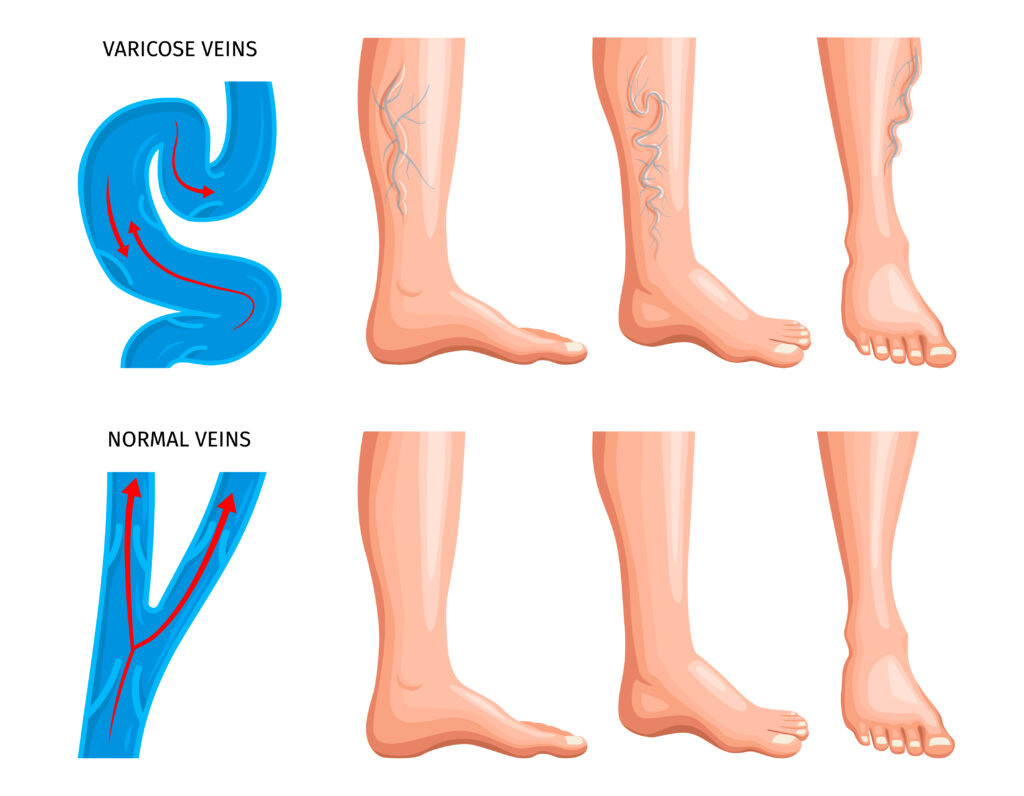
Spider Veins vs. Varicose Veins: What’s the Difference?
Understanding what you’re seeing on your legs helps guide the right treatment.
Spider veins are small, thin, web-like veins close to the skin’s surface. They’re usually red, blue, or purple, and while they’re often cosmetic, they can be the visible clue to a deeper venous problem.
Varicose veins are larger, twisted, rope-like veins that bulge above the skin. They’re typically symptomatic — heavy, achy, or tender — and are caused by faulty valves in the deeper saphenous veins. Varicose veins are a medical condition, not a cosmetic one.
The key point: spider veins on the surface can be a sign of venous reflux deeper inside the leg. Treating only the visible veins without addressing the underlying reflux is why many patients end up with recurrence after treatment elsewhere. A thorough ultrasound evaluation prevents this.
What Causes Vein Disease?
Venous insufficiency develops when the one-way valves inside your leg veins stop closing properly. Blood that should travel back toward the heart instead pools in the lower legs, raising pressure in the vein walls and causing them to stretch, bulge, and become symptomatic.
Risk factors include:
- Genetics — by far the strongest risk factor
- Pregnancy — each pregnancy increases risk
- Prolonged standing or sitting — common in nurses, teachers, hairstylists, retail workers, pilots
- Age — valve function naturally weakens over time
- Obesity — extra weight increases venous pressure
- Hormonal shifts — estrogen and progesterone weaken vein walls
- Prior blood clots (DVT)
- Florida’s climate — heat dilates veins and amplifies symptoms
If close family members have varicose veins, your risk is significantly higher — and earlier evaluation is worth considering.
How Vein Specialists Diagnose the Problem
A proper vein consultation in our Jupiter office includes three components:
- A focused medical history covering symptoms, family history, pregnancies, prior treatments, and lifestyle factors
- A physical examination of the legs in both standing and seated positions
- A duplex venous ultrasound — the gold standard — which maps your veins and identifies exactly which vessels are refluxing
Duplex ultrasound is painless, non-invasive, and usually completed the same day. It’s the single most important step in vein care because it tells us whether your problem is medical or cosmetic, and it allows us to plan a targeted treatment rather than guessing from the surface.
Modern, Minimally Invasive Vein Treatments
The days of painful vein stripping surgery are long over. Nearly all vein conditions are now treated in the office, in under an hour, with little or no downtime.
Sclerotherapy
Best for spider veins and small varicose veins. A tiny injection of a medical sclerosant causes the vein to collapse and gradually fade. Blood naturally reroutes through healthier veins. Most patients need 1–3 sessions. No anesthesia, no downtime — you walk in and walk out.
Endovenous Laser Ablation (EVLA) and Radiofrequency Ablation (RFA)
The modern replacement for vein stripping. A thin catheter is inserted into the faulty vein under ultrasound guidance and uses precise heat energy to seal it closed from the inside. The body absorbs the closed vein over time, and healthy veins take over circulation. Performed in-office under local anesthesia in about 45 minutes. Most patients return to normal activity the same or next day.
Ultrasound-Guided Foam Sclerotherapy
For deeper or tortuous veins that aren’t straight enough for laser treatment. Foam sclerosant is delivered directly into the problem vein under real-time ultrasound guidance — a highly effective option for veins that other techniques miss.
Compression and Medical Management
For patients who aren’t yet candidates for procedural treatment — or who want to manage symptoms while deciding — graduated compression stockings, lifestyle adjustments, elevation, and targeted exercise can meaningfully improve day-to-day comfort.

What to Expect at Your Jupiter Vein Consultation
Your first visit at Abacoa Podiatry & Leg Vein Center is straightforward:
- A 30–45 minute appointment
- Symptom review and leg examination
- Same-day duplex ultrasound when indicated
- A clear, honest explanation of findings
- A personalized treatment plan with cost and insurance transparency
Most patients leave the first visit knowing exactly what’s going on, what’s covered by insurance, and what the next steps are. No pressure, no sales script — just a plan.
Does Insurance Cover Vein Treatment?
In most cases, yes — when the condition is medical rather than cosmetic. Medicare and most major commercial insurance plans in Florida (including Florida Blue, Aetna, United, Cigna, and Humana) cover evaluation and treatment of symptomatic venous insufficiency.
Typical requirements include:
- Documented symptoms (pain, heaviness, swelling, skin changes, ulcers)
- A duplex ultrasound confirming venous reflux
- A trial of conservative therapy, usually 6–12 weeks of compression stockings
Purely cosmetic spider vein treatment is generally out-of-pocket and is priced transparently at our office.
We verify insurance benefits before any procedure so there are no surprises.
When to See a Specialist vs. Wait
You don’t need to be in severe pain to benefit from a vein consultation. In fact, the patients who do best are those who come in early.
Book an evaluation if:
- Your legs feel heavy, tired, or achy regularly
- Visible veins are worsening or new ones are appearing
- You’ve developed swelling, skin changes, or ankle discoloration
- You’re pregnant, postpartum, or considering pregnancy and have a family history
- You simply want to understand what’s happening and what options exist
Wait, and a treatable problem can progress into skin breakdown, stubborn wounds, or clot risk. The American Venous Forum considers early treatment the standard of care for this reason.
Why Patients Across Palm Beach County Choose Abacoa Podiatry & Leg Vein Center
Patients come to us from Jupiter, Abacoa, Palm Beach Gardens, Tequesta, Juno Beach, North Palm Beach, Stuart, and throughout northern Palm Beach County for a few specific reasons:
Board-certified physician expertise — Dr. Orlando Cedeno, DPM, FACFAS has performed thousands of lower-extremity procedures
In-office duplex ultrasound — no sending you elsewhere for imaging
The full range of modern vein therapies under one roof — sclerotherapy, laser ablation, radiofrequency ablation, and medical management
Personalized, unrushed consultations — we don’t run a vein mill
Transparent pricing and insurance verification before any treatment
Convenient Jupiter location just off Donald Ross Road, serving all of northern Palm Beach County
We treat both the medical and cosmetic sides of vein disease — so you feel better and look better.
Schedule Your Vein Evaluation in Jupiter
If your legs feel heavier than they should, or you’ve been putting off asking about those visible veins, the next step is simple: a painless evaluation, an honest answer, and a clear plan.
📍 Abacoa Podiatry & Leg Vein Center — Jupiter, FL 🌐 www.jupiterlaser.com 📞 561-624-4800
Schedule your vein consultation →
Frequently Asked Questions About Vein Treatment in Jupiter, FL
Are vein treatments painful? Modern vein procedures involve minimal discomfort. Sclerotherapy feels like a tiny pinch. Laser and radiofrequency ablation are performed under local anesthesia and are well tolerated — most patients describe them as far easier than expected.
Will my insurance cover vein treatment in Florida? If your vein disease is medical — meaning you have symptoms like swelling, heaviness, or skin changes and ultrasound confirms venous reflux — treatment is typically covered by Medicare and most commercial insurance plans. Cosmetic-only spider vein treatment is generally out-of pocket.
How long is recovery after vein treatment? Most patients walk out of the office and return to normal daily activity the same or next day. We ask you to avoid heavy lifting and high-impact exercise for about a week after ablation procedures, but walking is encouraged immediately.
Do veins come back after treatment? Treated veins do not return — they’re permanently closed and absorbed. However, the underlying genetic tendency toward vein disease remains, and new veins can develop over time. Periodic maintenance visits keep results looking and feeling their best.
How many treatments will I need? Most patients need 1–3 sclerotherapy sessions for spider veins. A single ablation procedure usually handles the main refluxing vein. Your specific plan depends on what your ultrasound shows.
How soon will I see results? Heaviness, aching, and swelling often improve within days of ablation. Cosmetic improvement from sclerotherapy develops gradually over 4– 8 weeks as treated veins are absorbed by the body.
Do I need a referral to see a vein specialist in Jupiter? In most cases, no. You can book directly with our office. We’ll verify your insurance and handle any referral requirements on our end.
Medically reviewed by Orlando Cedeno, DPM, FACFAS — board-certified podiatric surgeon and founder of Abacoa Podiatry & Leg Vein Center in Jupiter, FL. This article is for educational purposes and does not replace a medical evaluation. Individual results vary.